

Je veux déclarer un handicap
En tant qu’opérateur public, France Éducation international lutte contre toutes les formes de discrimination et garantit l’égalité de traitement des candidats, philosophie commune à l’ensemble du réseau de centres d’examen agréés DILF, DELF-DALF et TCF.
Conditions et règles
En application de la loi du 11 février 2005 et de la circulaire du ministère de l’éducation nationale, les centres d’examen doivent fournir à tout candidat qui signale un handicap altérant une fonction physique, sensorielle, mentale, cognitive ou psychique, l’installation matérielle ou l’assistance en personnel lui permettant de participer aux épreuves dans des conditions de travail de nature à rétablir l’égalité entre les candidats, ou d’être dispensé à l’une des compétences.
Les adaptations des épreuves du DILF, du DELF, du DALF ou du TCF (par exemple, remplacement d’un exercice) ne sont pas une option.
Pour bénéficier d’aménagements, le candidat doit fournir à son centre d’examen un certificat médical récent au moins deux mois avant la date de la session.
Le certificat médical doit dater de moins de 2 ans. Il peut être rédigé en français ou dans une autre langue compréhensible par le chef de centre. Le certificat émane d’une autorité médicale et comporte un diagnostic avec les aménagements recommandés pour un examen ou un test de langue étrangère.
Procédure
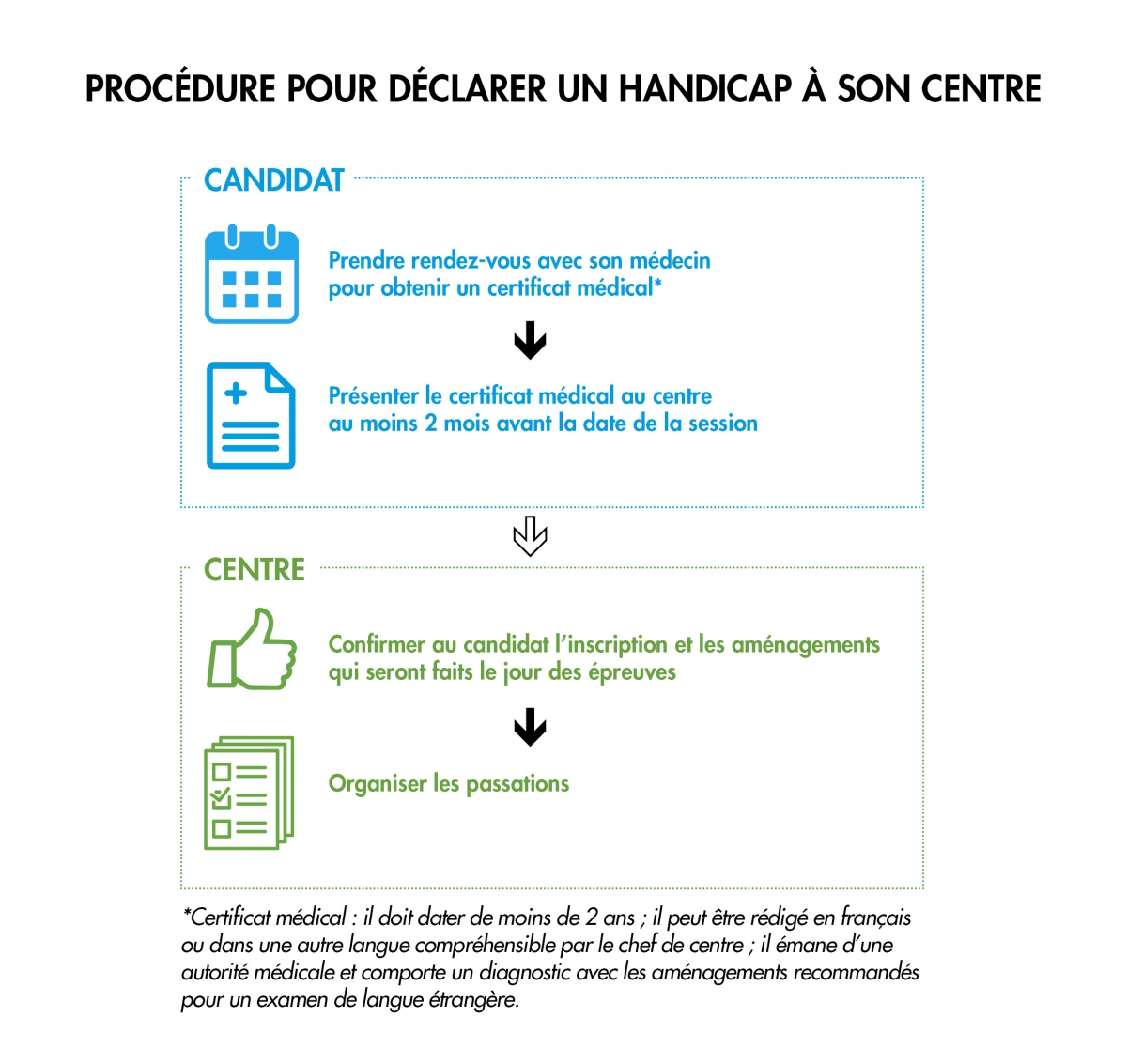
La procédure pour déclarer un handicap au centre d’examen est la suivante :
- Le candidat prend rendez-vous avec son médecin (ou une autorité médicale) pour obtenir un certificat médical qui détaille les aménagements recommandés.
- Le candidat présente le certificat médical au centre d’examen au moins 2 mois avant la date de la session.
- Le centre d’examen prend connaissance du certificat médical, analyse les aménagements recommandés (avec l’aide des services de France Éducation international si nécessaire) et confirme l’inscription au candidat ainsi que l’organisation des passations.
- Le centre d’examen planifie les passations selon les aménagements recommandés et prévoit le personnel nécessaire.
Aménagements possibles
Les aménagements possibles sont nombreux ; ils sont propres à chaque cas de handicap.
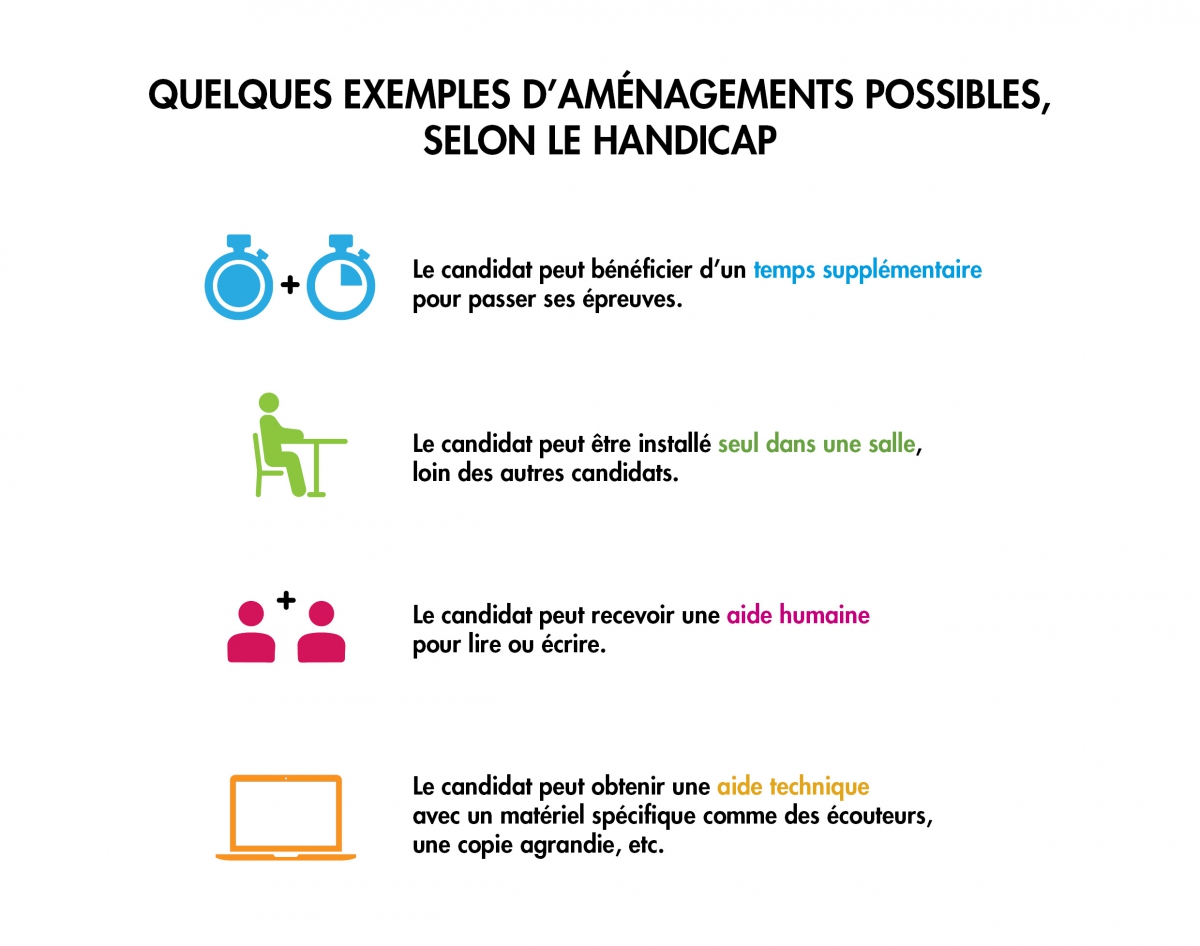
Voici quelques exemples d’aménagements fréquents :
- Durée des épreuves rallongée : le candidat peut bénéficier d’un temps supplémentaire pour passer ses épreuves.
- Salle adaptée : le candidat peut être installé seul dans une salle, loin des autres candidats, avec un surveillant préparé.
- Accompagnement humain : le candidat peut recevoir une aide humaine pour lire ou écrire.
- Aide technique : le candidat peut obtenir une aide technique avec un matériel spécifique comme des écouteurs, une copie agrandie, etc.
Les examens et les tests existent aussi en version braille. Les candidats sont invités à anticiper leur inscription (au moins 2 mois avant la date de la session) afin que les responsables des centres soient en mesure de commander le matériel dans les délais auprès de France Éducation international.
Une dispense d’une compétence est également possible (compréhension de l’oral par exemple). Dans ce cas, le candidat n’est pas éliminé et il réalise les autres parties de l’épreuve.
Pour toute question, les candidats doivent s’adresser à leur centre d’examen qui suivra les directives transmises par France Éducation international.
Textes de référence
Loi n° 2005-102 du 11 février 2005 : https://www.legifrance.gouv.fr/affichTexte.do?cidTexte=JORFTEXT000000809647&categorieLien=id
Circulaire n° 2015-127 du 3-8-2015 : https://www.education.gouv.fr/pid285/bulletin_officiel.html?cid_bo=91832